@beamnxw
Conspiracy tier list… yeah yeah I know I missed a few. Perhaps we can do a part 2. Flat earth is the mother of all conspiracies. That and the island files nonsense. This is all facts. [ flat earth, conspiracy, Lindsay Clancy, hoax, truth, cosmology, astrology, truther, astronomy, trial, nasa, space, moon landing, Artemis, moon mission, tinfoil, theory, tier list ] #tier #flatearth #conspiracy #hoax #truth
Emma Hayes' tactical breakdowns have actually been the best analysis I've ever seen on British TV. The problem is that distracting comments about immigration & antagonizing girlboss stunts like this are not going to endear women in football to anyone.
この「アプリの品質はやはりiOS」って言っている層って結局スマホを使っているんじゃなくてスマホに使われている層なんですよね。 大多数が、比較にしている対象がInstagramやTwitterなどの『公式』アプリで、これらに使われている人はそういう評価しかできないんですよね。
いやでも、お金なかったら「お金ないない」言うしかなくね?...と思いつつ、お金ないない言う親のもとで育ったらドケチのラスボス的な概念になってたので正しくはありそう。 お金には執着がありすぎて小学生の頃から駄菓子屋の10円パチンコで打ち子雇って金券ショップやって一周まわって飽きたけど くわしく書いたやつ置いとく⇩ 「わたしはそこそこ商売がうまくて、大金を稼ぐ能力はないけれど、ひとが数人食えるくらいの小さな生業なら昔からパッとつくることができる。具体的には小学生の頃からできる。というか、やっていた。」 https://pro-ogo.com/n/n0f6e5a962448#990cb7e5-5169-4b87-b460-658cc19a1187
Filesystem-Pilling Your Vertical Agent
색깔 없는 물 마시는데 노란 오줌이 나오네 어쩌면 내가 티백인가 봐
Sprawl District 02 #minecraftbuilds
プレステ1実機から 5600bps の超高速通信でBIOS取得できるようになった。モノラルなのでステレオで2倍にはできそうw
some of our fan base aren’t real
This is a live demo from the future!!! 🤯🤯🤯 An interactive sitcom? A playable episode? Games and movies are merging into one thing. I genuinely cannot stop playing this. Real-time video generation will change the entertainment industry forever. We are so close. Thanks to @fal team. @Hailuo_AI
Breaking news… my boners are now longer than 4 hrs Longer than > Titanic > Lord of the Rings (extended edition) Stats: > 4 hr 2 min > 5 episodes > 93% strength Out of database of 55,000 measurements: > 99th percentile among all males > 93rd percentile among men 20-25 years of age > 100% percentile among men my age > only 230 sessions exceed 4 hrs Nighttime erections (NTE) are a tier 1 longevity biomarker as critical to systemic health as VO2 max, resting heart rate, HRV, and blood pressure. Women have them nightly too. NTEs decline with age. Mine have been getting stronger over the past 18 months. This is a personal best. Low night time erection scores mean the following: > 2x risk of heart attack and stroke in next 4 years > early warning for cardiovascular problems > poor nervous system regulation Protocol for strong NTEs: > high sleep quality > cardiovascular fitness > tadalafil 5 mg - I take this longevity medication daily > calm nervous system
AI Semiconductor Endgame 2026 (III)
#theglasgowbible #glasgow #scottishtiktok #scottish #scotland
Taco tuesday, isn’t it?
Easily one of the best sample chop of all time
How to Use Graph Engineering to Build a Multi-Factor Alpha Model
The #1 question from my 1-2-3 article: What timeframe? Scalp: 15m → 5m → 1m. Manage 5m Day: 60m → 5m → 1m. Manage 5m Swing: Daily → 60m → 15m. Manage 60m. Position: Weekly → Daily → 60m. Manage Daily Read each line: map → setup → optional timing
@Inevitablewest Never forget this treason.
Oh my god. It's hard to express how big a positive impact this tip can have on your life if you talk to Claude a lot. > Tell Claude to write in ASD-STE100, or Simplified Technical English As a bonus, tell Claude to follow Zinsser's four principles of quality writing: 1. Simplicity 2. Brevity 3. Clarity 4. Humanity h/t @DanielLockyer
A billionaire trader has spent 40 years trying to delete a one-hour documentary. It shows him making $100 million in a single afternoon. He predicted the crash that made it possible three months in advance. He has never explained why he wants the film gone. His name is Paul Tudor Jones. The film is on YouTube. The documentary is called "Trader." PBS filmed it in 1987, three months before Black Monday. Jones was 32 years old, working from a small New York office, wearing shorts and a t-shirt, yelling at his phones, throwing paper across the room, and sleeping under his desk. The film captures him and his research partner Peter Borish overlaying a chart of the 1929 market on 1987, month by month. The two charts tracked within one percent. Borish said this is exactly what happened in 1929. Jones said if the analog holds, October is when it breaks. On October 19, 1987, the Dow fell 22.6 percent in a single day. It remains the largest one-day percentage loss in stock market history. That afternoon, Tudor Jones covered his shorts and made roughly $100 million. He was 33 years old. He was one of the very few traders on the street who came out ahead. He tried to bury the tape because it made him look reckless in a professional world that punished swagger. Twenty years of legal effort did not delete it. Someone kept a copy. It is on YouTube. It has fewer views than most makeup tutorials. The film is not really about a crash. It is about a specific philosophy of trading. Jones is shown building conviction slowly, sizing carefully, then striking hard when the setup arrives. He is never once shown making a random bet. He is shown doing the same thing five times a day, every day, for three months. His signature line, repeated across a 45-year career: "The most important rule of trading is to play great defense, not great offense." He does not try to be right. He tries not to lose. He sets stops tight, cuts positions fast, and never averages down on a loser. Every trade i…
This video is so wholesome I deadass teared up😭 my period must be coming😭😭
10 Words/Phrases that end the debate before it even starts
James O'Brien 'smiling'.
“BUCKET LOADS OF C*NT” 😳 Shocking Slip During Live Weather Forecast 😱 Picture the scene: BBC weatherman Alex Deakin is live on air, giving the forecast with a straight face. "By and large though, it’s simply a lovely winter’s day tomorrow… bucket loads of c*nt… er, sunshine… across central and eastern areas." 😂 You can almost see the exact moment his brain short-circuited. One second he’s describing pleasant weather, the next he’s accidentally promising the entire country bucket loads of something very different. 😭 The stutter, the correction, but carries on like a pro 🫡 What exactly was on this poor man’s mind mid-forecast? 🤔🤣
Weekly recap
@ScholarshipfPhd
عناصر الـGlass والعناصر العضوية السائلة.. من أسهل العناصر في تطبيقها وأكثرها جمالية.. عناصر مجانية تماماً ✨
The conspiracy prediction market is currently showing only 5.2% of volume thinks 3I/ATLAS is alien technology. Avi Loeb believers...now's the time to put your USDC where your beliefs are 👀
Alpha drop for $MOCK will be announced on this show
@RoundtableSpace 💥 LOADING UP 💥 $MOCK is not just a token. $MOCK is a movement against the system.
beamnxw ./
THIS GIF SHOWS THE ARCHITECTURE THAT TURNS YOUR STATELESS AI AGENT INTO AN AI ENTERPRISE MIND Agent capability = model + harness + memory + environment + evolution Memory types ➜ Session (one conversation, compacted) ➜ Files (MEMORY.md, episodic notes) ➜ Semantic (embeddings + graph index) Hierarchy ➜ Agent LTM (private, preferences) ➜ Shared LTM (team/hive, tribal knowledge) ➜ Client (agent-owned store) ➜ Server (governance, audit, versions) ➜ SoT stays read-only Inference loop ➜ Assemble (his…
New useful skill that tracks informative X accounts and collects key AI news, articles, projects and other important materials Works with Codex, Claude, Hermes, OpenClaw and others 3 steps: 1\ Set up X MCP - X API: https://docs.x.com/tools/mcp#x-mcp-%E2%80%94-x-api 2\ Install the skill from here: https://github.com/dair-ai/dair-academy-plugins/tree/main/plugins/x-agent-intelligence 3\ Run this prompt: "Use the x-agent-intelligence skill to create an autonomous local feed based on my X MCP conne…
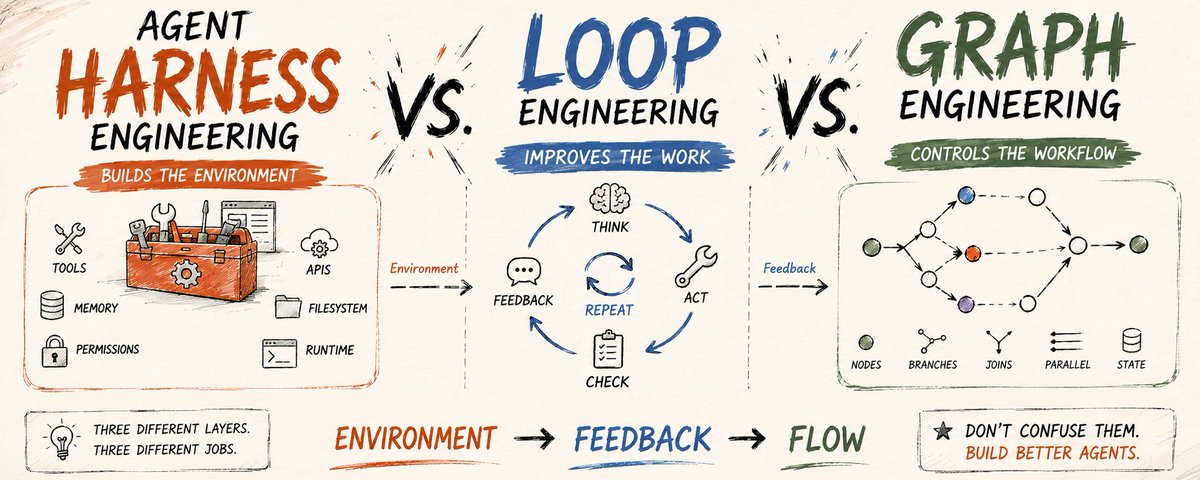
Agent Harness Engineering vs. Loop Engineering vs. Graph Engineering
This paper is f*cking brilliant A computer science paper proves that graph engineering is the missing layer for production AI systems The result: developers build stateful workflows using typed state, explicit nodes, conditional routing edges, and durable checkpointers The crazy part is how graph engineering strips control flow completely away from prompt text Graph nodes execute deterministic tools, edge functions evaluate execution state, and checkpointers preserve workflow memory across serv…