Build A Profitable Trading Strategy (in just 5 Steps)

A lot of people don’t even know where to start.
After 9 years of trading, this is my 5 step system that anyone can use to build a profitable trading strategy.
Let’s build.
The one shift that made me profitable
I spent 3 years building trading strategies that didn’t work.
I was putting in serious hours, I started with Elliott Waves (some extremely complicated TA). It worked for a bit, and then it stopped. So I tried RSI, MACD, moving averages, Ichimoku Clouds. Every time I thought I finally cracked it, the money dried up, and I went hunting for the next thing.
I can tell you exactly why none of it worked:
1) There was too much noise, I couldn’t tell whether a strategy was actually broken or whether I was just running it wrong.
2) No complete structure, always bits and pieces of a puzzle, always one component missing, and asking myself “should I really take this trade?”
3) A belief that sabotaged everything, “Why be consistent if I’m not consistently making money?”.
I needed to fix those three things, and I did it with one shift:
I stuck with a single, simple set of rules (even while it was losing me money).
The first thing that disappeared was the noise. I wasn’t scrolling X for new indicators or wondering which of ten setups was the real one. There was just one setup, and it was the same every time.
Then the structure started to click. When a trade appeared, I had only one question to answer: “Does this meet my rules?” If yes, I take it. If no, I don’t. No asking “what will price do next”, or “what’s this news going to do”. The rules already answered it.
Eventually, my mindset changed too. I stopped asking “why be consistent if I’m not making money” because I finally understood that the order runs the other way: consistency comes before profitability↓
Before we dive further, 1 thing (skip if you don’t like free trading alpha)

Consistency comes before profitability
Most traders view it the other way.
They think: find the strategy that makes money, then get consistent. So they hop from setup to setup and never stick with anything long enough to find out if it works.
The funny thing is, this isn't really a trading problem.
Picture a pharma company testing a new drug. Two ways to run the trial:
Approach A: all 30 patients, same dose, same time, same way.
Approach B: every patient, different dose, different mix, different timing.
Which one tells you if the drug works?
Only Approach A. There is too much changing all at once in Approach B for the results to mean anything.
Compare this with how most people trade. A lot of them have different setups, sizes, reasonings, and exits every time. Basically, Approach B.
There’s no clean test.
That’s what consistency is for.
And the part that trips people up: it barely matters which rules you pick first.
Decent rules run identically > “perfect” rules run differently.
Once your trades look the same every time, you’re on what I call the systematic loop™:

First loop’s usually unprofitable. So’s the second. Then you creep to breakeven, then past it. That’s the process working.
Most traders have been at this for years without completing one cycle. That’s why they are stuck. It’s not a bad strategy, just no loop.
Let’s talk about how to select a set of rules. I’ve broken it now into 5 pieces↓
1) Your foundation (the first of the five pieces)
Your foundation is made up of:
The idea of picking just one gives a lot of traders FOMO. You feel like you’re giving up an opportunity, but if you don’t keep it consistent, you can never get on the systematic loop.
Let me run you through what I suggest and why:
Asset → crypto. Think like a poker pro. You don’t sit down on Tuesday afternoon when the sharks are grinding. You play Saturday night, when the table’s emotional and having fun. Crypto is Saturday night. There’s less sophistication, more emotion, more edge to take.
Style → scalping. You’re fast in and fast out. More trades per day mean you hit the 30-100 trades of the systematic loop faster. Swing trading gets you a handful of trades a week. Same principle: pick the style that feeds the loop. One more reason is that it fits real life: a scalping session is a focused window; then you’re done. Nothing open, nothing to babysit. Swing traders are never fully off the clock.
Timeframe → 1 minute. Every candle is a data point, and the 1 minute gives you the most data in the least time. Most people call it “risky”, but it isn’t. It’s just a mirror: more trades mean bad habits show up faster, so you find out where you really stand quicker. (Full case for this in my 1-minute chart article; I’ll link it at the end in the bonus resources).
You don’t have to follow my suggestions by the way. What you choose matters less than just choosing one and staying with it. One asset, one style, one timeframe and no jumping between them. The point is consistency.
2) What’s the bet?
Foundation done. Now, what are you betting on?
Here’s what most people call a strategy: “I use EMAs, MACD, RSI and market structure. When I see confluence, I take the trade”.
Whilst it sounds impressive, it’s more a vibe than a strategy.
When exactly do you enter?
Which indicator decides?
What’s “confluence”?
There are no rules there, it’s just feeling based. And a feeling can’t be run the same way twice, so it can never go on the loop.
Every trade is one of two bets:

That’s it. (Technically there’s a third: no bet. If it’s not clearly one of the two, you don’t trade.)
Pick one and don’t overthink which. Traders naturally lean one way. When you look at a level, do you instinctively see it breaking or holding? That’s your bet.
Now you’ve gone from “I look for confluence” to a single, testable claim: this level breaks or this level holds. That’s a bet you can actually run 30 times and read.
3) You can’t predict the future; you read conditions
Most traders obsess over the perfect entry, which is really just a prediction in disguise.
Rather than trying to predict the future, try to read whether conditions favour your bet right now.
So before the trigger, two quick reads:
Is the environment right?
Is capital behind it?
Volume tells you if the move has conviction.

Conditions check out? Now the trigger and keep it simple:


You're going to want to add filters here. Resist it, at least until you've got data telling you which filter to add.
4) Be specific: exits.
Most people enter with no exit plan, figuring they'll "just know" when to get out.
Then price nears the stop and fear kicks in, or it nears profit and greed takes over. You can't think clearly in either spot. So you improvise, and every improvised exit corrupts your data. Do everything else right and blow this, and you're back to Approach B.
The fix: decide both exits before you enter.
Stop loss → where the bet is wrong. The exact price that proves your idea failed, rather than some round number you picked because it felt safe. On a momentum long, that's the higher low that held the trend. If it breaks, the trend's gone, so that's your stop.

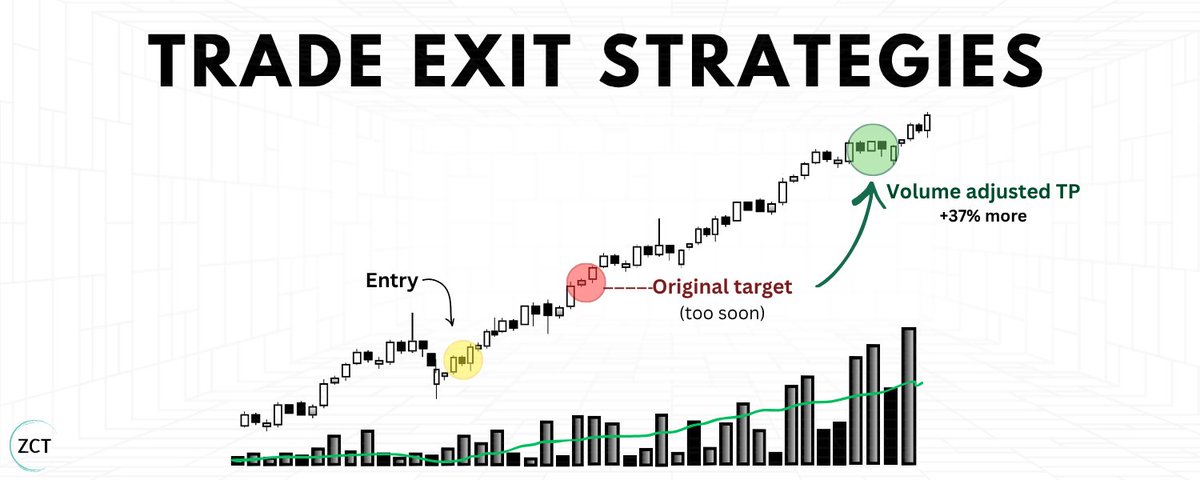
Take profit → keep it fixed at first. A flat 1R (you make what you risked). Yes, it's unambitious. That's what makes it useful. Chasing big 4R winners hides the flaws in your system; a tight fixed target forces your win rate to reveal them. You optimise for a high win rate first, stretch targets later.

And redefine what a win is. It's not green vs red. A win is: Did I follow my rules? Follow them and lose money → that's a win. Break them and profit → that's a loss.
I learned this on MATIC. It was ripping 50%+ in a day, and I was taking my 5-10% and getting out per my rules. People thought I was mad, leaving all that on the table. But I'd already proven the strategy worked; my only job was to run it again, the same way. That discipline gave me my first five-figure day. I didn't catch the whole move. I just refused to deviate, and that was worth more.
5) Risk is more important than edge
Your rules can be perfect and still wipe you out.
A trader I know turned a six-figure account into ~$200M in a bull run. Three months later, he was in debt, borrowing money. He was risking too much, and one bad stretch took all of it. I have never once seen someone keep money made without a risk foundation.
Most "risk management" isn't. "I move my stop to breakeven." "I only use 2x leverage." None of that answers the one important question of: how much am I risking per trade?
Two rules to start:

One last rule: if you slept under six hours, don't trade that day. I know how soft that sounds, but it's cost me more money than any bad setup ever did. A tired brain breaks rules, and broken rules are how good strategies lose money. Your sleep is part of the system, whether you like it or not.
Next Steps
Write out your 5 rules for your strategy, gather 30-100 trades and start your first systematic loop.
And check out my free 7 day course.