

I Gave Claude David Ogilvy's Writing Rules And Built A Legendary AI Writing Coach

Legendary marketer David Ogilvy generated over $864 million for his clients.
He was a British advertiser known as "The Father of Advertising."
And in 1982, Ogilvy sent this 1-page memo to his staff:
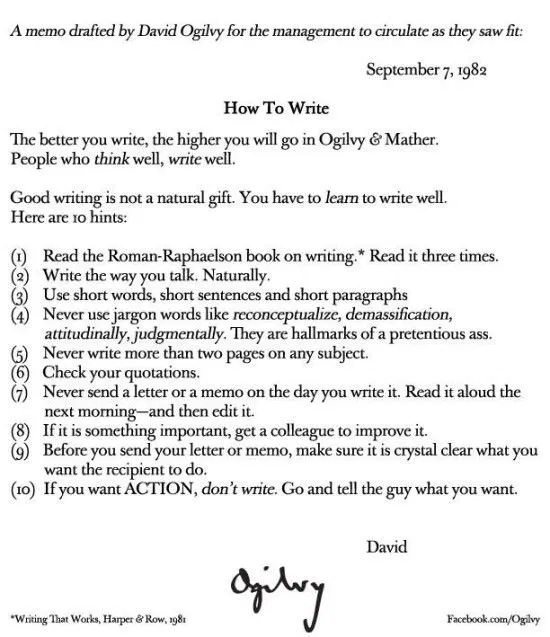
These are the 10 writing rules he lived by.
And the memo starts with a clear promise:
"The better you write, the higher you will go in Ogilvy & Mather. People who think well, write well. Good writing is not a natural gift. You have to learn to write well."
Now, replace "Ogilvy & Mather" with any company, and this holds true.
So, I trained Claude on all 10 of these rules and turned it into a free writing coach.
It audits any piece of writing:
Against Ogilvy's principles and tells you exactly what's broken—and more importantly, how to fix it.
You can grab that Skill at the end of this Article.
But first, I want to break down these 10 rules. Because even in the age of AI, you need to understand these.
Let’s dive in!
1. Read the Roman-Raphaelson book on writing. Read it 3 times.
Every company on Earth would be a better place if this book was required reading.
If you are still sending emails with walls of text, read this.

2. Write the way you talk. Naturally.
"Finding your writing voice" is a waste of time.
You already have your voice — the one you use every day.
Here's how to start using it in your writing:
Then, transcribe it and start there.
3. Use short words, sentences, and paragraphs.
This one takes practice.
But the easiest way to find when you're being too wordy?
Read everything aloud before you publish it.
When you find yourself getting caught up, it's a sign you need to simplify.
4. Never use jargon.
When someone uses jargon, they're hiding their lack of understanding.
Instead, pretend you are writing to an 8th grader.
5. Never write more than 2 pages on any subject.
99% of books should be blog posts.
And 99% of blog posts should be LinkedIn posts.
But it’s worth keeping in mind:
Never publish more than two pages on any subject.
So if it can't fit in two pages, it should be simpler.
6. Check your quotations.
This one is simple enough.
7. Never send a letter or memo on the day you write it. Read it aloud the next morning, then edit it.
This is the number one piece of writing advice I give people.
If you are publishing something important, always, always, give it room to breathe.
And always read it aloud.
8. If it is something important, get a colleague to improve it.
This pairs nicely with point number 7.
If it's something really important, write it, give it a day, edit it, then send it to a colleague.
9. Before you send your letter or memo, make sure it is crystal clear what you want the recipient to do.
This is so simple, but easy to forget.
Put yourself in the reader's shoes and identify exactly the next step they should take after reading.
Then, articulate that step for them.
10. If you want ACTION, don't write. Go tell the guy what you want.
Last and most importantly, writing is never a replacement for a targeted conversation.
Most messages should be conversations, especially ones that require action.
I built a system that helps you apply all 10 of these rules.
Because most writing feedback is vague.
"This isn't quite working" or "tighten it up" doesn't help you improve as a writer.
Meanwhile, the principles that produce sharp business writing are well-documented—but scattered across books, memos, and decades of practice.
So I turned Ogilvy's 1982 memo (plus the Roman-Raphaelson principles he pointed to) into a Claude Skill that audits any piece of writing against all 10 rules.
Here's how this Claude Skill works.
Let's say I'm writing an email, a landing page, or an internal update—and something feels off but I can't tell why.
Instead of spending 30-60 minutes rereading, second-guessing, and trying to articulate the problem—I run the Ogilvy Skill.
In seconds, I get:
The skill doesn't rewrite anything for me.
I use it to keep internalizing these rules so I still do the rewriting.
And because this has already saved me so much time (and made everyone on our team a sharper writer)…
I'm going to share this Claude Skill for free.
Inside, you'll get:
Want access?